Leading Traditional Institutions Through Change – a discussion with Oxford University Vice-Chancellor and The Bishop of Oxford
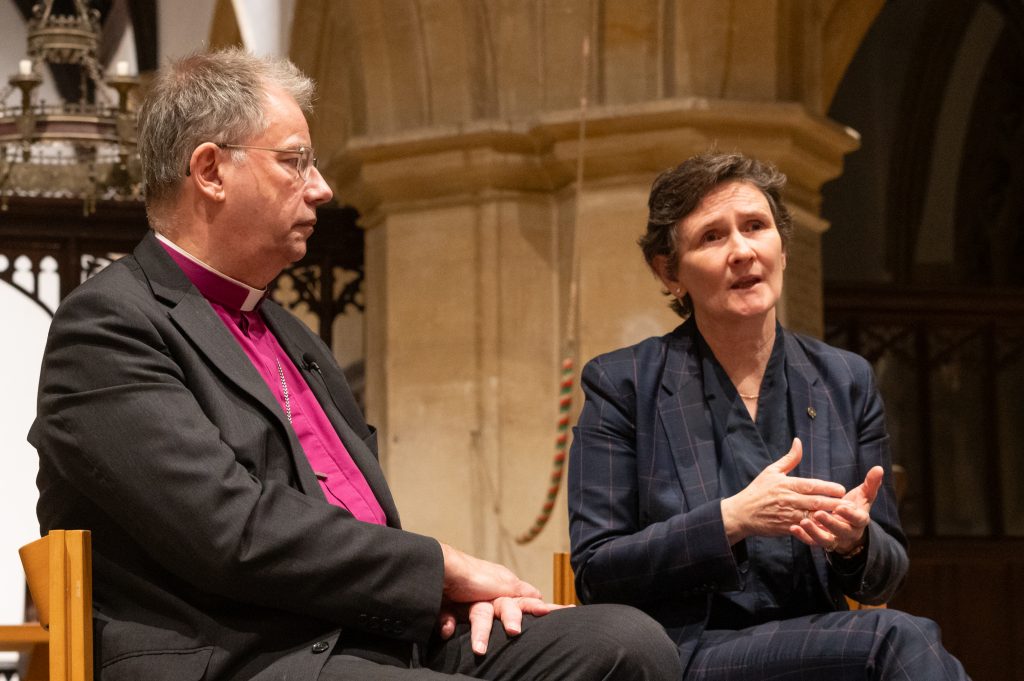
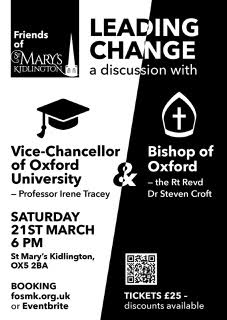
Professor Irene Tracey, Vice-Chancellor of Oxford University, and The Rt Rev. Steven Croft, Bishop of Oxford, two of Oxford’s most influential leaders came together for a rare public conversation: “Leading Change”. Both are grappling with profound contemporary challenges while honouring their historic legacies.
The conversation was facilitated by Joanna Foster CBE, Programme Director for the Friends and herself a well seasoned leader of major national and Oxford organisations. She described the event as “a truly unique opportunity to hear two remarkable leaders discuss the real challenges of steering ancient institutions into the future. Both Oxford University and the Diocese of Oxford face questions that test the very essence of leadership – how do you honour tradition while meeting the scientific, spiritual and social demands of the 21st century?”
Thanks to Danby Bloch for providing a full write-up of the evening:
The University of Oxford and the Church of England Diocese of Oxford are at the heart of many key national and international debates and controversies – so a discussion about leadership between the heads of these organisations promised to be fascinating. And it was. In front of an interested audience in St Mary’s Kidlington, Prof Irene Tracey, Vice Chancellor (aka chief executive) of the University of Oxford and the Rt Revd Dr Steven Croft Bishop of Oxford were gently interrogated by Joanna Foster CBE, no stranger to leadership issues herself as a former Chair of the UK Equal Opportunities Commission.
All three are closely connected to Kidlington; Irene attended Gosford Hill School before becoming a leading Oxford neuro-scientist, while both Steven and Joanna live within a few hundred yards of St Mary’s.
It was a wide-ranging conversation and started off with the equal opportunities and diversity, a topic that has grown more controversial in the woke culture wars. Both bishop and vice chancellor were clear on the need for clarity about their mission.
For Oxford University, the aim is excellence in both teaching and research – get that right and everything else follows, including diversity. “If we are serious about excellence, you will naturally attract a group of people that will be diverse in every sense of the word.”
The crucial task for the university’s leadership is to foster inclusion so that all can thrive. Good data and powerful stories can help persuade colleagues of the case for change. She pointed to the lack of gender parity – only 29% of top professors are women – to counter complacency. “That’s not acceptable. They should be at 50 percent. We’ll get there, but there is still work to do.” She cited the bank Goldman Sachs’ success in boosting women partners by creating a competition with bonus awards for male partners who mentored women to promotion.
Steven observed that there was still some way to go before there was gender and ethnic workplace parity in the church, reflecting on his journey from impatience with church reform to valuing the parish church’s stability while still pressing for essential changes.
He cited three approaches to leading change: honour the pioneers like the first women priests and the first Black incumbents. Then, engage deeply with theological tradition in diversity debates, even though that can slow change. Finally though, “If, the church starts to talk about equality and diversity more than we talk about Jesus and the love of God and love of neighbour, then something important shifts from the centre of the life of the church.”
In his view, the Anglican conversation at a national level is rather stuck, although there’s some progress. Locally, he has led in favour of greater change, accepting the resulting disagreements. He expects this will be central in selecting his successor.
For Irene Tracey, free speech and academic freedom are foundational for teaching and research. Social media is a major challenge as a toxic source of hatred, but it’s outside university control and work is needed to help students navigate that toxicity. Yet despite media narratives, she is clear that free speech is vibrant and healthy in universities.
Both leaders are concerned about the state of public discourse: “Just because something is legal to say, doesn’t mean you should say it; words have consequences,” as Irene Tracey observed and the bishop agreed.
Asked about the recent debate on Muslim prayers in Trafalgar Square, Steven
warned the audience to listen to how such public debates affect Jewish and Muslim communities; he also warned about “political movements on the right appropriating Christian symbols for their narrow agendas.”
The discussion moved onto the challenges posed by artificial intelligence (AI).
Steven who is an AI expert worries that it is largely driven by tech-company interests, not consumers or citizens, leading to, “significant risks in terms of people’s mental health, in terms of addictive behaviours which are encouraged.” He is also concerned about the concentration of power and wealth in a few untrustworthy tech companies, which challenge democratic institutions. “The advice I’m offering when asked is try and make your church or institution as human as possible and be really cautious about the adoption of technology…..”
Irene was more optimistic about AI, “There’s nothing new in AI. Machine learning, which is one of the ways that the underlying algorithms work today in AI, has been around for 30 years.” Calling it “artificial intelligence” just created unnecessary fear.
The university is providing ChatGPT to all students and staff to teach responsible usage and ensure data privacy. “And we’re the only institution who’s done it so far – to give everybody staff and students ChatGPT for free.”
The university’s goal is to combine deep subject knowledge with AI skills and a strong ethical foundation to make graduates exceptionally employable. “We have the preciousness of this tutorial system that we’re going to pack full with the ability to think, to think critically, to think in a cognitive dissonance way, to handle debate and to know how to problem solve.”
It was left to the Rector of Kidlington Felicity Scroggie to thank the speakers for the fascinating insights they had given the audience.